
Reverse osmosis (RO) is one of the most widely used technologies for industrial water treatment, but stable RO operation depends on careful control of feedwater chemistry. Among the key parameters, pH plays an important role in pretreatment, membrane operation, scaling control, and chemical cleaning.
Proper RO system pH adjustment can help control carbonate scaling, manage dissolved CO₂, support downstream water purification, and improve membrane cleaning effectiveness. However, pH control is not simply about maintaining a fixed number. The appropriate setpoint depends on feedwater chemistry, membrane characteristics, recovery rate, and the specific treatment objective.
In this guide, we explain the key principles of RO system pH adjustment across pretreatment, first-pass permeate treatment, and membrane cleaning. A practical case study is also included to illustrate how systematic pH optimization can help restore RO system performance.
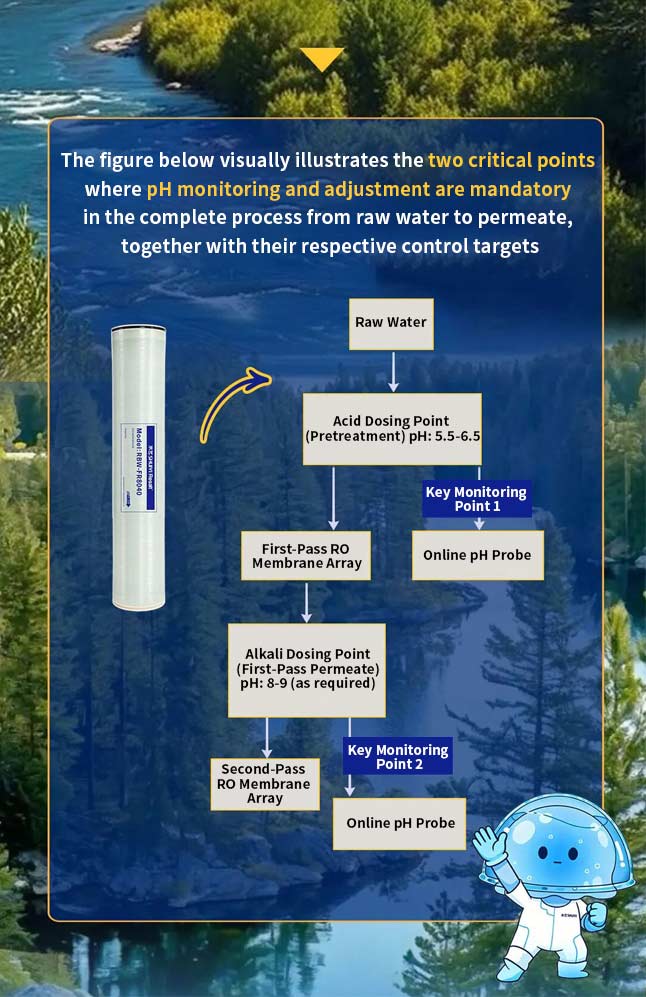
1.Pretreatment Stage: Acid Dosing forProactive Scale Control
Objective: To prevent carbonate scaling (especially CaCo3) and protect the structural integrity of the RO membranes.
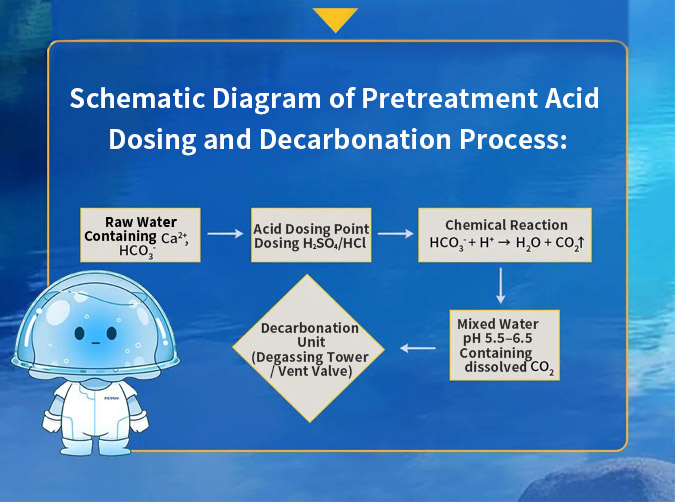
Principle Overview: During the RO concentration process, if the pH is relatively high, HCO3– in the raw water can readily react with calcium and magnesium ions to form carbonate precipitates that attach to the membrane surface. By dosing sulfuric acid or hydrochloric acid and maintaining the feedwater pH at 5.5-6.5, bicarbonate can be converted into carbon dioxide through the following reaction:
HCO₃⁻ + H⁺ → H₂O + CO₂↑
This converts scale-prone bicarbonate into dissolved CO2, thereby reducing the scaling risk at the source.
Practical Considerations:
- Dosing PointSelection: Acid dosing is recommended upstream of the cartridge filter, together with a static mixer to ensure thorough mixing of the acid with the raw water, avoiding localized low-pH c
- pH Control Accuracy: Itis recommended to maintain pH fluctuations within ≤0.5. Excessively low pH may increase the risk of corrosion in stainless steel piping, while excessively high pH may leave a significant scaling risk. The pH setpoint should therefore be evaluated and adjusted in conjunction with the LSI.
- Post-treatment of CO2: Adecarbonation tower or degassing device should be installed to prevent CO2 from entering the RO sys Otherwise, residual CO2 may pass through the RO membrane and increase permeate conductivity, affecting permeate quality.
2.Advanced Treatment Stage: Alkali Dosing to Reduce Final Conductivity
Objective: For first-pass RO permeate, alkali dosing is used to neutralize dissolved CO2 and significantly reduce the conductivity of the final permeate or the feedwater to downstream treatment units such as EDI or polishing mixed-bed ion exchanger. This helps improve final permeate quality.
Principle Overview: First-pass RO permeate typically contains dissolved CO₂ gas, which dissolves in water to form carbonic acid (H₂CO₃), partially dissociating into H⁺ and HCO₃⁻, resulting in elevated permeate conductivity. By dosing NaOH and increasing the pH to 8.0–9.0, the following reactions are promoted:
CO₂ + OH⁻ → HCO₃⁻
HCO₃⁻ + OH⁻ → CO₃²⁻ + H₂O
This process converts dissolved CO₂, which behaves as a weak acid in water, into bicarbonate and carbonate species while consuming H⁺, thereby helping reduce permeate conductivity. It creates more favorable feedwater conditions for downstream advanced treatment units, such as EDI or polishing mixed-bed systems, reduces their treatment load, and helps extend the overall service life of the treatment process.
Practical Considerations:
- Dosing Point and Mixing: The alkali dosing point should be located on the first-pass RO permeate line, upstream of the intermediate water tank or downstream treatment units. A static mixer must be installed to ensure rapid and uniform mixing of the alkali solution and prevent localized high-pH conditions.
- pH Control Range: It is recommended to maintain the first-pass RO permeate pH at 8–9. If the pH is too low, CO2 neutralization may be incomplete; if the pH is too high (>9.5), metal precipitation may occur, potentially affecting downstream EDI or mixed-bed units.
- Conductivity Monitoring and Interlock: An online conductivity meter must be installed downstream of the alkali dosing point and interlocked with the dosing pump to enable automatic dosing adjustment and ensure stable water quality.
3.Cleaning and Maintenance Stage: Dynamic pH Adjustment to Restore Membrane Performance
Cleaning Strategy:
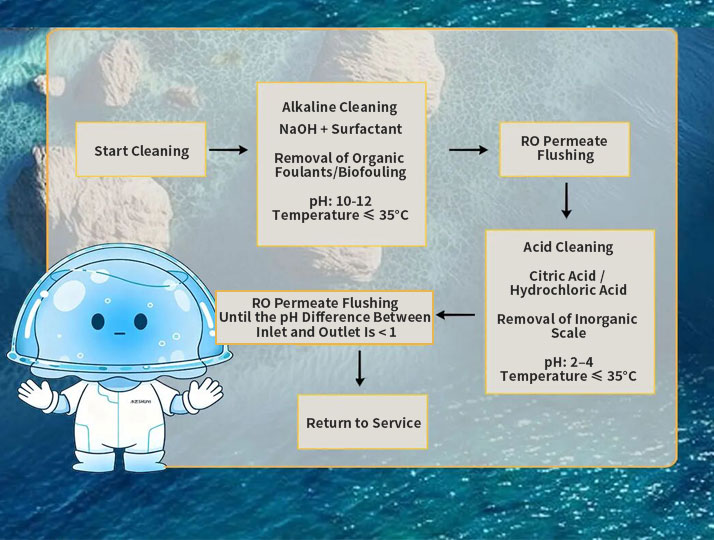
Acid Cleaning (pH 2–4): Commonly performed using citric acid or hydrochloric acid to remove metal oxides and carbonate scale.
Alkaline Cleaning (pH 10–12): NaOH, combined with surfactants, is used to effectively remove organic foulants, biofilms, and silica deposits.
Practical Considerations:
- Recommended Cleaning Sequenced: Alkaline cleaning should be performed first to remove organic foulants, followed by acid cleaning to remove inorganic scale. Reversing the order may generate gelatinous precipitates and aggravate fouling.
- Strict Temperature Control: The cleaning solution temperature should not exceed 35°C to avoid thermal aging of the membrane elements.
- System Restoration Procedure: After cleaning, the system must be thoroughly flushed with RO permeate until the pH difference between the inlet and outlet is less than 1 before being returned to service.
4.Case Study: Improving RO Performance Through pH Optimization
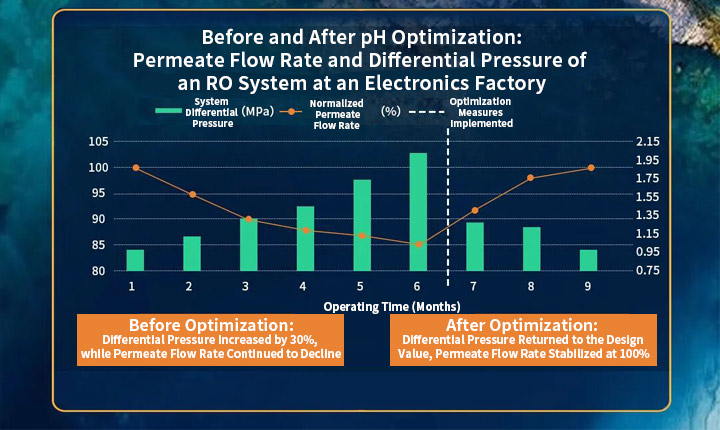
This facility uses an RO process to produce ultrapure water. The raw water has high hardness and a relatively high silica content. After six months of operation, the membrane differential pressure increased by 30%, while the permeate flow rate declined.
Problem Analysis: pH control in the pretreatment stage was unstable, fluctuating between 6.8 and 7.2, resulting in minor CaCO₃ deposition. Meanwhile, to control silica scaling, the operating pH was raised to 9.5, but no additional biocide treatment was implemented, leading to biofouling.
Solutions:
- An automatic pH control system was installed upstream of the cartridge filter to maintain the pretreatment pH at 6.0 ± 0.2.
- The operating pH was maintained at 9.0, and a non-oxidizing biocide was dosed once per week.
- Sequential cleaning, with alkaline cleaning followed by acid cleaning, was performed every three months.
Results:
After three months, the system differential pressure returned to the design value, permeate quality stabilized, and the membrane service life is expected to be extended by approximately 40%.
The figure below compares the permeate flow rate and system differential pressure before and after pH adjustment in the following case.
5.Key Operating Rules
- Monitor by Data, Not by Feel: Online pH monitoring must be installed upstream of the high-pressure pump and interlocked with the dosing pump to enable automatic dosing control.
- No Blind Spots in Safety: The chemical dosing area must be equipped with eyewash stations and adequate ventilation. Operators shall wear appropriate chemical-resistant protective equipment and receive regular safety training.
- Quantified Dosing and Validation: Theoretical calculations, such as the LSI, must be combined with pilot-scale testing to avoid water quality fluctuations caused by “experience-based” dosing.
6.Conclusion
Although pH adjustment may not be as prominent as high-pressure pumps or membrane housings, it is critical to the long-term stable operation of an RO system. From scale prevention and performance optimization to cleaning and maintenance, precise pH control at every stage contributes to extending membrane service life and reducing overall operation and maintenance costs.
Operators are encouraged to establish systematic pH monitoring and adjustment logs based on the specific characteristics of their feed water, enabling the RO system to truly “be data-driven and operate under control.”